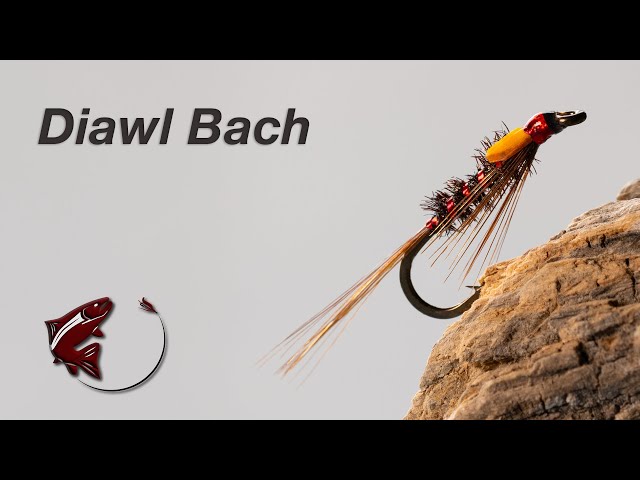
The Diawl Bach is a great Baetis/Mayfly nymph pattern that is most commonly seen in British and Scottish fly tying. However, I'm seeing it more here in North America.
Start the thread behind the hook eye and take wraps until the thread is between the hook point and the barb. Tie in seven or eight fibers from a brown Coq de Leon feather so they extend about a hook shank in length beyond the tie-in point using just a couple of wraps. Next, tie in a strand of red Halotinsel in the same spot with a couple of wraps. Finally, tie in two pieces of peacock herl, dyed red, in the same location. Now advance the thread with touching turns to about two eye lengths behind the eye, securing the butt ends of the Coq de Leon, Halotinsel, and peacock herls. Snip off any remaining material.
Dab a thin superglue coat across the hook's top shank over the thread wraps. Take touching wraps of the peacock herl until you are two eye lengths behind the eye, secure it, and remove the excess. Next, take open wraps of the Halotinsel to the point where the peacock herls are tied off. Secure it and remove the excess.
Returning to the Coq de Leon feather, take about ten fibers, with their tips even, from its stem. Measure them so they extend backwards, just reaching the hook point. Place them underneath the hook shank and secure them in place. Trim the butt ends of the fibers. Bring the thread about two and a half hook eye lengths behind the hook eye. Remove two amber-colored goose biots from the very base of the stem, keeping them held together. Trim just a bit of each corner of the biots to give them a rounded look. Each biot will have an inward curve. Secure one biot to each side of the hook extending backwards to create two orangish cheeks on the fly. Wrap forward towards the hook eye, and remove the tip from each biot.
At the base of the biots just tied in, secure a bit of the remaining red Halo tinsel and advance the thread to the hook eye. Add a small dab of superglue to the thread wraps, and then take overlapping wraps of the Halo tinsel up to the hook eye. This will create a nice red head on the fly. Whip finish behind the eye and remove the thread. I will add a thin coat of UV resin over the red Halo tinsel to secure everything and make the red really pop. With that, the fly is ready for the box!
Start the thread behind the hook eye and take wraps until the thread is between the hook point and the barb. Tie in seven or eight fibers from a brown Coq de Leon feather so they extend about a hook shank in length beyond the tie-in point using just a couple of wraps. Next, tie in a strand of red Halotinsel in the same spot with a couple of wraps. Finally, tie in two pieces of peacock herl, dyed red, in the same location. Now advance the thread with touching turns to about two eye lengths behind the eye, securing the butt ends of the Coq de Leon, Halotinsel, and peacock herls. Snip off any remaining material.
Dab a thin superglue coat across the hook's top shank over the thread wraps. Take touching wraps of the peacock herl until you are two eye lengths behind the eye, secure it, and remove the excess. Next, take open wraps of the Halotinsel to the point where the peacock herls are tied off. Secure it and remove the excess.
Returning to the Coq de Leon feather, take about ten fibers, with their tips even, from its stem. Measure them so they extend backwards, just reaching the hook point. Place them underneath the hook shank and secure them in place. Trim the butt ends of the fibers. Bring the thread about two and a half hook eye lengths behind the hook eye. Remove two amber-colored goose biots from the very base of the stem, keeping them held together. Trim just a bit of each corner of the biots to give them a rounded look. Each biot will have an inward curve. Secure one biot to each side of the hook extending backwards to create two orangish cheeks on the fly. Wrap forward towards the hook eye, and remove the tip from each biot.
At the base of the biots just tied in, secure a bit of the remaining red Halo tinsel and advance the thread to the hook eye. Add a small dab of superglue to the thread wraps, and then take overlapping wraps of the Halo tinsel up to the hook eye. This will create a nice red head on the fly. Whip finish behind the eye and remove the thread. I will add a thin coat of UV resin over the red Halo tinsel to secure everything and make the red really pop. With that, the fly is ready for the box!
- Category
- Fly Fishing
- Tags
- tying flies, fly fishing, trout fishing
Post your comment
Up Next
Autoplay
-
10:10

Tying a Leggy Diawl-Bach with Davie McPhail
-
10:09
Tying the Mosaic Diawl Bach with Davie McPhail
-
13:30
Diawl Bach - Multipurpose Stillwater Wet Fly
-
16:32
Silver Doctor Atlantic Salmon Fly Tutorial
-
09:15
CrushCity™ Crew | Alexander Wiltz
-
Dick Came to Canoe /SONGS OF MY LIFE /Shilkloper, Swingle's Bach, Guitar Trio's 9th Sym, Il Postino
-
07:12
Fly Tying Tutorials The Olive Diawl Bach
-
16:18
The Winged Diawl Bach
-
13:37
Phát hiện và bắt bạch tuộc sống dưới lớp cát ở bãi biển thật tài tình
-
09:30
Ultralight Smallmouth Fishing w/ Ryan Crouser | Offseason Adventure
-
Fly Fishing In The Black Hills
-
Roving the River for Specimen Pike
-
HATCH - BIG SKY PMDs - Montana Fly Fishing By Todd Moen
-
Fly Fishing In Some Of The Best Trout Fishing Water I Have Ever Seen!