Title: Examining spatiotemporal shifts in steelhead angling effort and the utility of recreational catch data for assessing abundance in British Columbia
Speaker: Julie Charbonneau
Abstract: Recreational fisheries represent complex socio-ecological systems. Angler effort can be
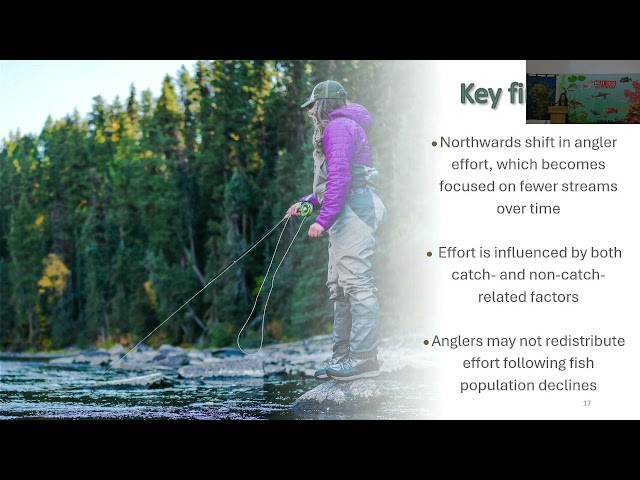
driven by local or global social factors, ranging from expanding human populations, shifting social norms to the dynamics of fish populations. Yet in many cases, recreationally targeted species lack fisheries-independent monitoring, and angler catch and effort metrics remain the best available data to infer information about population status and trends. Here, examining steelhead trout (Oncorhynchus mykiss) recreational fisheries in British Columbia (BC) Canada we 1) quantify spatio-temporal shifts in angler effort and catch rates, and 2) assess the utility and limitations of recreational-catch-per unit-effort (CPUE), as an index of spawner abundance.
Patterns of catch and effort were assessed in over 200 steelhead-bearing streams during a 60-year period that included major shifts in abundance of several stocks. We discovered that effort varies through time, and regionally. Steelhead fisheries in some regions have collapsed completely, while angler effort has expanded in other regions, revealing a spatial restructuring of the fishery. However, there are relatively few long-term monitoring programs for steelhead which creates major uncertainties. Thus, we quantified the relationship between angler CPUE from the recreational fishery and fisheries independent abundance indices in 14 streams. Our findings reveal sweeping patterns of hyperstability, indicating that when populations are depressed, CPUE does not decrease as rapidly as abundance. Taken together, these findings showcase the collapse and expansion of a globally renowned recreational fishery, and highlight the challenges, opportunities and limitations of using recreational fishery data to monitor the status of this at-risk species.
Speaker: Julie Charbonneau
Abstract: Recreational fisheries represent complex socio-ecological systems. Angler effort can be
driven by local or global social factors, ranging from expanding human populations, shifting social norms to the dynamics of fish populations. Yet in many cases, recreationally targeted species lack fisheries-independent monitoring, and angler catch and effort metrics remain the best available data to infer information about population status and trends. Here, examining steelhead trout (Oncorhynchus mykiss) recreational fisheries in British Columbia (BC) Canada we 1) quantify spatio-temporal shifts in angler effort and catch rates, and 2) assess the utility and limitations of recreational-catch-per unit-effort (CPUE), as an index of spawner abundance.
Patterns of catch and effort were assessed in over 200 steelhead-bearing streams during a 60-year period that included major shifts in abundance of several stocks. We discovered that effort varies through time, and regionally. Steelhead fisheries in some regions have collapsed completely, while angler effort has expanded in other regions, revealing a spatial restructuring of the fishery. However, there are relatively few long-term monitoring programs for steelhead which creates major uncertainties. Thus, we quantified the relationship between angler CPUE from the recreational fishery and fisheries independent abundance indices in 14 streams. Our findings reveal sweeping patterns of hyperstability, indicating that when populations are depressed, CPUE does not decrease as rapidly as abundance. Taken together, these findings showcase the collapse and expansion of a globally renowned recreational fishery, and highlight the challenges, opportunities and limitations of using recreational fishery data to monitor the status of this at-risk species.
- Category
- Steelheads
- Tags
- WRFC, 11th WRFC, recreational fishing
Post your comment
Up Next
Autoplay
-
06:06

Global wine map changes as climate change hits
-
05:38
Travel Trends of 2026
-
05:18
Fish Hunting || Big Carp Fish Rohu Catching || Fishing Trends | Kerala River Fishing
-
49 degree summer killed my trout stream, Global warming? ultra light 0# fishing and tenkra
-
Russian Fishing 4 My First Global Record Linear Albino Carp
-
Global Cybersecurity Pulse: From Ethical Hacker Triumphs to Satellite Safeguards
-
Global Fuel & Food Prices Up, July Snow in British Columbia (647)
-
The Rise Of Global Green Development & Renewable Energy Mega Projects
-
Getting Tuna Lines Out on The Julie Ann - WB Oregon
-
Can UAE oyster farmers rival their global competitors?
-
Fly Fishing In The Black Hills
-
Roving the River for Specimen Pike
-
HATCH - BIG SKY PMDs - Montana Fly Fishing By Todd Moen
-
Fly Fishing In Some Of The Best Trout Fishing Water I Have Ever Seen!